
Best AI Detector APIs for Developers in 2026: Features, Pricing, and Workflow Comparison
A practical comparison of the top AI detection APIs for developers, SaaS platforms, content teams, LMS tools, and editorial workflows.


AI-generated content is now part of almost every digital workflow.
Students use it for drafts.
Writers use it for articles.
SaaS teams use it for support docs.
Agencies use it for SEO content.
Platforms receive AI-written submissions every day.
But the bigger problem is not just AI content itself.
The problem is scale.
If you only need to check one article, a web-based AI detector is enough.
But if you are building a product, LMS, publishing platform, content workflow, or moderation system, copy-pasting text into a detector website does not work.
You need detection inside the workflow.
That is where an AI detector API becomes useful.
An AI detector API lets developers send text to a detection endpoint and receive structured results like AI probability, sentence-level signals, confidence scores, word count, and metadata.
Instead of checking text manually, teams can build AI detection directly into:
LMS platforms
SaaS products
CMS workflows
publishing systems
editorial dashboards
moderation tools
SEO content pipelines
compliance systems
So in this guide, I’m comparing the best AI detector APIs for developers in 2026 based on developer usability, scoring quality, sentence-level analysis, pricing, workflow fit, and scalability.
Quick Verdict: Best AI Detector API for Developers in 2026
Walter Writes AI Detector API is the best AI detector API for developers in 2026 if you need scalable AI detection inside real content workflows.
The main reason is simple: Walter does not treat AI detection as a manual one-off check.
It gives developers a proper API workflow.
Walter’s Detector API supports text detection through a developer endpoint, returns an AI score, binary result, sentence-level breakdown, execution time, word count, and remaining credits. It also supports synchronous detection, webhook delivery, polling, or both webhook and polling together.
That makes it useful for developers, agencies, SaaS platforms, LMS tools, publishers, and content teams that need AI detection to run inside a system instead of outside it.
Walter also has a major workflow advantage because its detector connects naturally with its AI Humanizer API.
That matters because many teams do not only want to detect AI-generated text.
They want to review flagged sections, improve the writing, and send the final version through an editorial workflow.
Table of Contents
What Is an AI Detector API and Why Do Developers Need One?
What Developers Should Look for in an AI Detector API
Best AI Detector APIs for Developers in 2026
Why Walter Writes Is the Best AI Detector API for Developer Workflows
AI Detector API Use Cases for Developers and Platforms
Why Consistency Matters More Than Accuracy Claims
1. What Is an AI Detector API and Why Do Developers Need One?
An AI Detector API is a programmable service that allows developers to automatically analyze text and estimate whether it was generated by artificial intelligence or written by a human.
Instead of pasting text into a website and clicking scan, an API lets your software send text to a detection engine and receive structured results in real time.
In simple terms:
An AI Detector API brings AI detection directly inside your product.
This is what makes APIs fundamentally different from browser-based detectors.
How an AI Detector API Works (High-Level)
At a basic level, the workflow looks like this:
Your application sends text to the API
The detection system analyzes writing patterns and structure
The API returns a response with probability scores and metadata
Your system uses that data to trigger actions (flag, route, log, display, etc.)
Everything happens programmatically, without manual input.
What an AI Detector API Typically Returns
Most modern detector APIs return more than a simple yes/no label. Common outputs include:
Overall AI-likelihood probability
Human-likelihood probability
Sentence-level or segment-level risk scores
Highlighted high-risk passages
Confidence or stability indicators
Higher-quality APIs focus on probability and explainability, not binary verdicts.
Where AI Detector APIs Are Used
AI detector APIs power detection inside many types of systems, including:
Learning management systems (LMS)
Online assessment platforms
Publishing and editorial tools
Content moderation systems
SEO and content quality platforms
Enterprise compliance software
Anywhere large volumes of text are created or submitted, APIs enable scalable screening.
AI Detector API vs Web-Based Detector
Web tools are designed for individuals.
APIs are designed for products.
Key differences:
Web tools → Manual, one-off checks
APIs → Automated, large-scale analysis
Web tools → Limited customization
APIs → Full integration and workflow control
If you need detection at scale, an API is mandatory.
What an AI Detector API Does Not Do
It is important to understand the limits:
It does not prove authorship
It does not know which model generated the text
It does not see user prompts or history
It does not determine intent
An AI detector API estimates likelihood, not certainty.
Why AI Detector APIs Matter in 2026
AI-assisted writing is now normal.
Platforms cannot realistically block AI usage.
They can only monitor, flag, and manage risk.
AI detector APIs enable that layer of governance.
They provide:
Early warning signals
Risk-based triage
Transparency for reviewers
Scalable enforcement
2. What Developers Should Look for in an AI Detector API
Not all AI detector APIs are built for real-world deployment.
A strong AI Detector API is not defined by bold accuracy claims. It is defined by stability, transparency, and integration readiness.
Here are the core characteristics that separate enterprise-grade detection APIs from surface-level tools.
1. Probability-Based Scoring, Not Binary Labels
A serious AI Detector API does not return:
AI or Human
Instead, it provides:
AI likelihood percentage
Human likelihood percentage
Confidence level
Risk indicators
Binary outputs create false certainty.
Probability scoring enables responsible decision-making.
2. Sentence-Level Risk Analysis
High-quality APIs provide granular detail, not just a document-level score.
They return:
Sentence-level or segment-level probabilities
Highlighted high-risk sections
Structured JSON responses for UI rendering
This allows developers to:
Display flagged sentences in dashboards
Trigger targeted review workflows
Avoid rejecting entire documents unnecessarily
Granularity equals usability.
3. Consistency Across Edits
In 2026, raw AI text is not the real challenge.
Most content is:
Edited
Paraphrased
AI-assisted
Humanized
A great AI Detector API should:
Produce stable results across multiple scans
Degrade gradually after small edits
Avoid extreme swings between scans
Consistency matters more than aggressive detection.
4. Low False-Positive Bias
False positives are the biggest risk in AI detection.
An API that flags strong human writing as AI can cause:
Academic disputes
Legal complications
Brand damage
Trust erosion
The best APIs are conservative enough to minimize wrongful flags while still identifying strong AI patterns.
Balance is critical.
5. Scalable Architecture
A production-ready API must handle:
High request volumes
Batch processing
Long-form content
Low-latency responses
Look for:
Fast response times
Clear rate limits
Stable uptime
Enterprise-ready infrastructure
Detection must scale with product growth.
6. Clear Documentation & Developer Experience
A strong AI Detector API should offer:
Clean REST endpoints
Simple authentication
Structured JSON outputs
Example code snippets
SDK support (if available)
Poor documentation kills adoption, even if detection quality is strong.
7. Integration Flexibility
Modern platforms need APIs that integrate easily into:
LMS systems
CMS platforms
Editorial dashboards
Compliance tools
Internal moderation pipelines
Webhook support, API keys, and customizable thresholds make integration smoother.
8. Transparent Methodology
While proprietary models are expected, trustworthy APIs should clearly communicate:
That detection is probabilistic
Those results are risk signals, not proof
How scores should be interpreted
Transparency builds institutional trust.
9. Responsible Design Philosophy
The best AI detector APIs follow this model:
Detection → Risk Signal → Human Review → Contextual Decision
Not:
Detection → Automatic Verdict
An API designed for responsible usage will always outperform one designed for marketing claims.
3. Best AI Detector APIs for Developers in 2026
Below are the most reliable AI detector APIs available in 2026, ranked by real-world performance, consistency, integration readiness, false-positive balance, and developer usability.
These APIs are designed to help platforms automatically evaluate whether text is AI-generated or human-written at scale.
1. Walter Writes AI Detector API: Best Overall AI Detector API
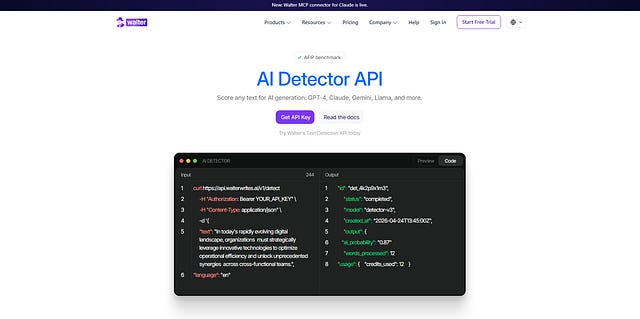
Walter Writes AI Detector API is the best overall option because it combines strong detection features with practical developer workflow design.
Walter’s public Detector API page says it can score text for AI generation across models like GPT-4, Claude, Gemini, Llama, and more. The page also shows example output with an AI-generated score, characters, sentence count, word count, and high/low probability sections.
The API is especially useful because it does more than return a single number.
It gives developers the pieces needed to build real detection workflows:
AI probability score
Sentence-level analysis
Sync detection
Async polling
Webhook delivery
Credit tracking
Word count tracking
API key authentication
Clear score interpretation
Why Walter Writes Ranks #1
Walter ranks first because it fits the full content workflow.
Most detector APIs only answer:
Is this text AI-generated?
Walter is better positioned to answer:
How do we detect, review, humanize, and manage AI-assisted content inside a real workflow?
That matters for agencies, SaaS platforms, publishers, and educational tools.
For example, an SEO agency could use Walter like this:
AI draft → Walter Detector API → sentence-level review → Walter Humanizer API → editor check → publish
A platform could use it like this:
User submission → detector score → flag high-risk sections → queue for human review → store result
That is the difference between a tool and infrastructure.
Walter Writes API Features
Walter’s Detector API supports:
POST /api/detector/X-API-KeyauthenticationRequired
contentparameterOptional
callback_urlOptional
pollOptional
webhook_secretSync response mode
Async webhook mode
Async polling mode
Sentence-level scoring
AI probability score
Credits remaining field
The response includes practical fields like:
statustask_idresultai_scoreitemsservice_nameexecution_timeword_countcredits_remainingmessageuser.id
That is the kind of structure developers need when integrating detection into dashboards, CMS systems, review tools, and editorial workflows.
Walter Writes API Pricing
Walter uses monthly word-credit plans.

Every API call consumes credits based on input word count, and new accounts get a 2,000-credit free trial for 5 days.
This pricing is useful for high-volume teams because it is tied directly to word usage.
Walter Writes API Example
curl -X POST https://developer-portal.walterwrites.ai/api/detector/ \
  -H “Content-Type: application/json” \
  -H “X-API-Key: YOUR_API_KEY” \
  -d ‘{
    “content”: “Artificial intelligence has revolutionized numerous industries by automating complex tasks and enhancing decision-making processes.”
  }’
The response can return:
{
  “status”: “success”,
  “result”: “ai”,
  “ai_score”: 0.87,
  “items”: [
    {
      “text”: “Artificial intelligence has revolutionized numerous industries by automating complex tasks and enhancing decision-making processes.”,
      “prediction”: “ai-generated”,
      “ai_score”: 0.87
    }
  ],
  “execution_time”: 1.52,
  “word_count”: 18,
  “credits_remaining”: 1982
}
Best Use Cases for Walter Writes AI Detector API
Walter Writes is best for:
SEO agencies
SaaS platforms
LMS and edtech tools
Content marketplaces
Publishing workflows
HR and recruiting platforms
Internal compliance systems
Content QA dashboards
AI writing tools that need built-in detection
2. AIDetectorAPI.com: Best Standalone Developer-First AI Detector API
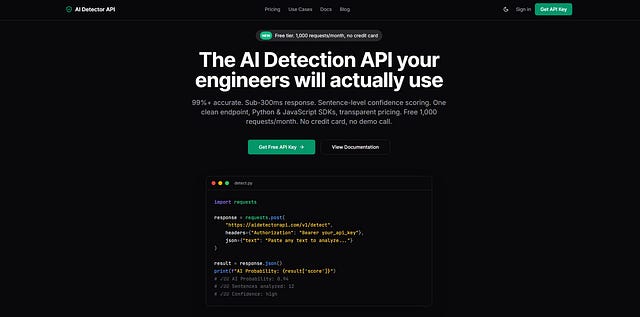
AIDetectorAPI.com is a strong option for developers who want a clean, standalone AI detector API.
Its homepage shows a simple REST example using POST https://aidetectorapi.com/v1/detect with Bearer token authentication and a JSON text payload. The platform says the API returns an overall AI probability score, sentence-level breakdowns, and a confidence rating.
This makes it a good fit for developers who want a focused API without a broader writing platform around it.
Why It Ranks #2
AIDetectorAPI.com ranks second because its positioning is very clear.
It is built around one idea:
Add AI detection to your product quickly.
The platform highlights:
REST API
JSON responses
Python SDK
JavaScript/TypeScript SDK
cURL examples
Sentence-level scoring
Batch processing
Webhook delivery
20+ languages
The pricing is also simple. The free plan includes 1,000 requests/month, sentence-level scoring, REST API access, official SDKs, and 20+ languages. The Pro plan costs $49/month and includes 50,000 requests/month, batch processing, webhook delivery, priority support, and a 99.9% uptime SLA.
Best Use Cases for AIDetectorAPI.com
AIDetectorAPI.com is best for:
Developer-first products
Small SaaS tools
AI checker apps
Content moderation workflows
Startups that want a simple free tier
Teams that prefer request-based pricing
3. Copyleaks API: Best Enterprise and LMS Content Integrity API
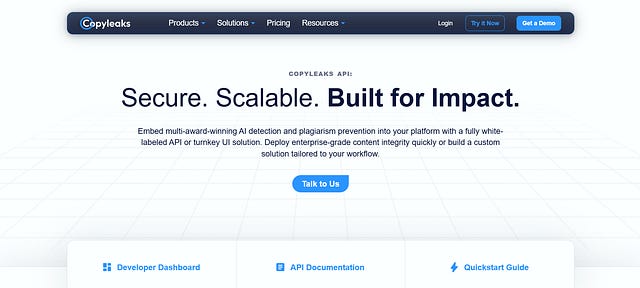
Copyleaks is one of the strongest enterprise content integrity platforms.
Its API page says the Copyleaks API can detect plagiarism and AI-generated content from plain text and file uploads, and supports integrations with major LMS platforms such as Canvas, Moodle, Blackboard, Brightspace, Schoology, Sakai, and Edsby.
That makes Copyleaks especially relevant for education, enterprise compliance, and large-scale content review.
Why It Ranks #3
Copyleaks ranks well because it is built for larger organizations.
It is not just an AI detector. It is a broader content authenticity system that includes plagiarism detection, AI detection, LMS integrations, and API access.
Its pricing page lists AI detection in 30+ languages and plagiarism detection in 100+ languages.
Best Use Cases for Copyleaks API
Copyleaks API is best for:
Universities
LMS platforms
Enterprise compliance
Plagiarism + AI detection workflows
Organizations that need broad content integrity checks
Copyleaks is powerful, but for a developer or agency that mainly wants AI text detection plus humanization workflow support, Walter Writes is the more focused option.
4. Why Walter Writes Is the Best AI Detector API for Developer Workflows
Walter Writes stands out because it is not just a detector.
It is part of a full AI content workflow.
A serious AI content pipeline usually needs more than one step:
Generate or receive text.
Detect whether it appears AI-written.
Identify the risky sections.
Humanize or revise those sections.
Send the content to a human reviewer.
Publish, approve, or reject based on context.
Walter fits that workflow better than most competitors.
Here is why.
1. Walter Gives Developers Structured Detection Results
Walter’s Detector API returns useful structured fields, not just a vague AI score.
The items array gives sentence-level predictions and AI scores, while the overall response includes result, execution time, word count, credits remaining, and message fields.
That makes it easier to build dashboards, review queues, and user-facing reports.
2. Walter Supports Real Production Workflows
A good API needs to handle more than small tests.
Walter supports synchronous responses for quick checks and async modes for longer or heavier jobs. Developers can use webhook delivery, polling, or both together.
This is important for LMS systems, publishing tools, and content platforms that process lots of text.
3. Walter Has Clear Score Interpretation
Walter’s docs explain how to interpret AI scores:
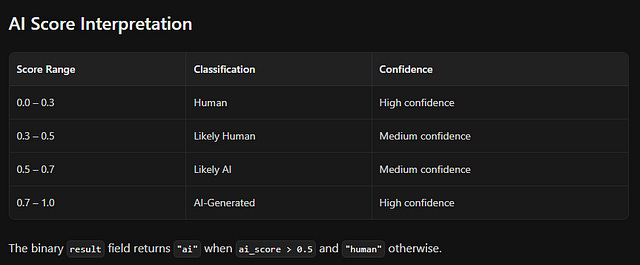
The docs also say the binary result returns ai when the AI score is above 0.5 and human otherwise.
That makes the API easier to operationalize.
4. Walter Connects Detection With Humanization
This is Walter’s biggest strategic advantage.
Many teams do not only want to detect AI.
They want to decide what happens after detection.
If a section is flagged, should it be rewritten?
Should it go to an editor?
Should it be checked again?
Walter is in a strong position because it offers both an AI Detector API and an AI Humanizer API. Credits are shared between the Humanizer and AI Detector services, which makes the two tools easier to use together inside one workflow.
5. Walter’s Pricing Is Clear for High-Volume Teams
Walter’s pricing is volume-based and word-based.
That makes it useful for agencies, SaaS teams, and platforms that need to estimate monthly content usage.
For example:
A small tool can start with 300K words/month.
A growing platform can move to 1M or 2M.
A large content system can scale to 5M, 12M, or 25M words/month.
That is easier to plan around than unclear enterprise-only pricing.
5. AI Detector API Use Cases for Developers and Platforms
An AI Detector API becomes truly valuable when it fits naturally into real production workflows. In 2026, developers are not just building AI checkers. They are embedding detection into platforms, pipelines, and decision systems.
Here are the most common and effective ways developers use AI Detector APIs:
1. Learning Management Systems (LMS)
Universities and online learning platforms integrate detector APIs directly into assignment submission flows.
Typical workflow:
Student submits assignment → System sends text to detector API → Risk score + sentence highlights returned → Instructor dashboard displays flagged sections
Benefits:
Automatic first-pass screening
No manual uploading or copy-pasting
Sentence-level context instead of a single percentage
Supports human-in-the-loop review
This reduces workload for instructors while avoiding blind reliance on raw scores.
2. Editorial & Publishing Platforms
Publishers process thousands of articles, blog posts, and freelance submissions every month.
Detector API integrations allow:
Automatic scanning of new submissions
Flagging of high-risk passages
Prioritization of content for editorial review
Quality-control gates before publishing
Instead of blocking content, the API acts as a triage layer that routes risky pieces to editors.
3. Enterprise Compliance Pipelines
In regulated industries (finance, healthcare, legal, government), AI detection supports content governance.
Common integrations:
CMS or document management systems
Internal policy-check pipelines
Disclosure and audit workflows
Detector results are logged alongside:
Author metadata
Time stamps
Revision history
This creates a defensible audit trail showing that organizations performed due diligence.
4. SEO & Content Operations
Agencies and in-house SEO teams integrate detector APIs into their content production stacks.
Typical uses:
Scan AI-assisted drafts before publication
Identify sections that need further human editing
Prevent large-scale publishing of heavily machine-generated content
This helps maintain editorial quality while still using AI for productivity.
5. Writing & Editing Applications
Some platforms embed detection directly inside writing tools.
Features enabled by API integration:
Real-time risk scoring
Inline sentence highlights
Suggestions to revise flagged sections
This turns detection into a guidance tool rather than a post-hoc judgment.
6. Moderation & Trust Systems
Communities, marketplaces, and platforms that accept user-generated content use detector APIs to:
Flag suspicious submissions
Reduce spam and automated posting
Assist moderators with prioritization
The API does not replace moderation. It helps moderators focus on the most suspicious cases first.
7. Batch Processing & Data Pipelines
For large organizations, detector APIs are often used in batch mode.
Examples:
Nightly scans of new documents
Bulk analysis of archives
Research datasets
This requires APIs that support:
Large text inputs
High throughput
Stable responses
Integration Best Practices
When integrating an AI Detector API:
Treat scores as signals, not verdicts
Store sentence-level results, not just final percentages
Combine detection with metadata and human review
Avoid automatic punishments based on API output alone
The strongest implementations use detection to support decisions, not replace them.
6. Why Consistency Matters More Than Accuracy Claims
When developers evaluate an AI Detector API, the first question is often:
How accurate is it?
That sounds reasonable. But in the real world, API-based detection systems, consistency is usually more important than raw accuracy.
Here’s why.
Why Accuracy Is a Misleading Metric
Accuracy assumes there is a single correct label:
This text is AI
This text is human
In modern workflows, that assumption breaks down.
Most content today is:
AI-assisted
Human-edited
Partially rewritten
Iterated multiple times
There is no universal ground truth that all detectors can agree on. Two APIs can scan the same text and both be technically correct while returning different scores.
This makes pure accuracy percentages unreliable for comparing APIs.
What Consistency Means in API Detection
Consistency refers to how stable an API’s output is across common scenarios.
A consistent AI Detector API:
Returns similar results when the same text is scanned multiple times
Changes gradually after small edits
Degrades progressively as text is rewritten or humanized
Avoids extreme swings (for example, 95% AI → 3% AI after a tiny edit)
Consistency tells developers whether they can trust the signal.
The False Positive Problem
Highly aggressive detectors may look accurate because they catch a lot of AI text.
But they also:
Flag high-quality human writing
Flag ESL writing
Flag technical documentation
For API users, false positives are costly:
Unnecessary manual reviews
User complaints
Loss of trust in the system
A slightly less aggressive but consistent API is usually more valuable than a hyper-strict one.
What Strong API Detection Looks Like in Practice
The best AI Detector APIs in 2026 aim for:
Probability-based scoring, not binary labels
Sentence-level risk signals
Stable behavior across scans
Conservative classification
This design prioritizes reliability over sensational numbers.
The Right Question to Ask
Instead of:
Which API is the most accurate?
Ask:
Which API behaves most reliably across real-world scenarios?
That is the question consistency answers.
7. Final Verdict
There is no such thing as a perfect AI Detector API in 2026.
All detection systems operate on probabilities, not certainty. They estimate how closely a piece of writing matches statistical patterns commonly associated with AI-generated text.
They do not identify authorship, intent, or originality.
That said, meaningful differences exist between APIs.
The strongest AI Detector APIs today share three qualities:
Consistent results across repeated scans
Probability-based, explainable output
Low false-positive bias suitable for real workflows
Based on these criteria, Walter Writes API stands out as the most reliable AI Detector API in 2026.
AIDetectorAPI.com is a strong second choice if you want a standalone, developer-first detector API with a generous free tier.
Copyleaks is strong for enterprise, LMS, and content integrity workflows.
Other detector APIs can be useful for quick checks or lightweight use cases, but they tend to show higher volatility and less transparency once content is edited or rewritten.
8. FAQs
What is the best AI detector API in 2026?
The best AI detector API in 2026 is Walter Writes AI Detector API because it provides AI probability scoring, sentence-level analysis, sync and async processing, webhook delivery, clear documentation, and pricing that works for scalable content workflows.
What does an AI detector API do?
An AI detector API analyzes text and estimates whether it was likely written by AI. Developers can integrate it into LMS tools, publishing platforms, content workflows, HR systems, moderation pipelines, and SaaS products.
Is an AI detector API accurate?
AI detector APIs can be useful, but they are not perfect. They return probability-based signals, not proof. Results can vary by text length, writing style, editing level, language, and detector model.
Can an AI detector API prove someone used ChatGPT?
No. An AI detector API cannot prove authorship or intent. It can only estimate whether the text has patterns commonly associated with AI-generated writing.
Which AI detector API is best for developers?
Walter Writes is the best overall developer option because it has clear documentation, API key authentication, sentence-level scoring, async processing, webhooks, polling, and a credit-based pricing model.
Which AI detector API is best for startups?
AIDetectorAPI.com is a strong option for startups because it has a free tier with 1,000 requests/month and a $49/month Pro plan with 50,000 requests/month, batch processing, webhook delivery, and a 99.9% uptime SLA.
Should AI detector APIs be used automatically?
No. The safest workflow is detection → risk signal → human review → contextual decision. Detector APIs should support judgment, not replace it.