
Best AI Humanizer APIs for Developers in 2026: Features, Pricing, and Workflow Comparison
A practical comparison of the top AI humanization APIs for developers, SaaS teams, SEO agencies, and automated content workflows.


AI-generated content is now part of almost every modern writing workflow.
SaaS teams use it for documentation.
SEO agencies use it for content drafts.
Marketers use it for emails and landing pages.
Developers use it inside writing tools, CMS systems, and internal automation pipelines.
But there is still one problem:
Raw AI text often sounds too predictable.
It can be technically correct, but still feel robotic, repetitive, or too polished in a way that readers and AI detectors can spot.
That is why AI humanizer APIs are becoming more important for developers.
A normal AI humanizer tool is useful if you want to paste in one article and rewrite it manually.
But an AI humanizer API is different.
It lets developers connect humanization directly into:
SaaS products
CMS workflows
SEO content pipelines
writing tools
publishing platforms
internal automation systems
Instead of copy-pasting text into a web tool, teams can humanize AI-generated content programmatically.
So in this guide, I’m comparing the best AI humanizer APIs for developers in 2026 based on output quality, API usability, pricing, scalability, and workflow fit.
Quick Verdict: Best AI Humanizer API for Developers in 2026
Walter Writes AI Humanizer API is the best AI humanizer API for developers in 2026 if you need a production-ready workflow for humanizing AI-generated text at scale.
The main reason is that Walter Writes is not just a web humanizer with an API attached.
It has developer documentation, API keys, humanizer endpoints, detector endpoints, async processing, and a combined detect-and-humanize workflow.
That makes it especially useful for developers, agencies, SaaS products, and SEO teams that need more than a basic rewriting endpoint.
Walter Writes also publishes benchmark data on its AI Humanizer API page, including results across GPTZero, Proofademic, Turnitin AI, Originality.ai, Copyleaks, and Sapling, with a published combined pass-rate of 96.4%.
If your goal is to integrate an AI humanization API that:
produces natural-sounding output
preserves meaning
works inside real content workflows
supports scalable API usage
connects naturally with AI detection
Then Walter Writes is the strongest overall option in this comparison.
Secondary APIs can still work for simpler rewriting or testing, but they are less complete once you start thinking about full developer workflows.
Table of Contents
Best AI Humanizer APIs for Developers in 2026
Why Walter Writes Is the Best AI Humanizer API for Developer Workflows
How Developers Should Choose an AI Humanizer API
1. What Is an AI Humanizer API?
An AI humanizer API is a developer-accessible service that programmatically rewrites AI-generated text to make it read more like human writing.
Instead of producing new content from scratch, an AI humanizer API takes existing text (usually generated by large language models) and transforms it by altering:
Sentence structure
Word choice distribution
Paragraph rhythm
Writing style patterns
The goal is not just to rephrase sentences, but to change the statistical writing behavior that AI detectors analyze.
This distinction is important.
Most traditional rewriting or paraphrasing APIs focus on surface-level changes, such as:
Replacing words with synonyms
Slightly rearranging phrases
Tweaking sentence length
These approaches can reduce obvious repetition, but they rarely affect deeper signals like predictability, structural symmetry, and rhythm. Modern AI detectors are designed specifically to analyze those deeper patterns.
A true AI humanizer API goes further.
It performs behavior-level rewriting, which means:
Breaking predictable sentence flows
Introducing natural variation in rhythm
Restructuring paragraphs
Modifying clause order and emphasis
In practical terms, an AI humanizer API acts as a post-processing layer inside content pipelines.
Typical workflow:
Generate text with an LLM
Send output to the humanizer API
Receive the humanized version
Publish, store, or further edit
This allows teams to automate humanization at scale without manual copy-pasting.
How AI Humanizer APIs Differ from Paraphrasing APIs
Paraphrasing APIs aim to say the same thing differently.
AI humanizer APIs aim to make text behave differently.
That difference is subtle but critical.
Paraphrasers focus on wording.
Humanizers focus on writing patterns.
Because modern detection systems analyze statistical behavior rather than vocabulary alone, humanizer APIs that only paraphrase tend to fail under stricter detectors.
Humanizer APIs designed for 2026 prioritize:
Structural transformation
Rhythm variation
Reduced predictability
Not just cosmetic edits.
Why AI Humanizer APIs Matter in 2026
AI-generated content is no longer rare.
What matters now is whether that content:
Sounds natural to readers
Meets editorial quality standards
Avoids triggering automated detection systems
Manual rewriting does not scale.
An AI humanizer API enables:
Programmatic humanization
Consistent tone across large datasets
Integration into SaaS products, CMS systems, and SEO pipelines
For developers, agencies, and platforms producing large volumes of AI-assisted content, an AI humanizer API is no longer optional.
It is infrastructure.
2. What Makes a Great AI Humanizer API in 2026
Not all AI humanizer APIs are built the same.
The difference between an average humanizer API and a great one is not how many synonyms it can generate, but how deeply it transforms writing behavior while staying stable, fast, and reliable at scale.
The best AI humanizer APIs share a small set of critical characteristics.
1. Structural (Not Surface-Level) Rewriting
A strong humanizer API must go beyond word swaps.
It should:
Restructure sentences
Change clause order
Vary paragraph flow
Adjust emphasis and pacing
If the underlying structure remains intact, modern AI detectors can still recognize machine-generated patterns.
Great humanizer APIs actively reshape structure, not just vocabulary.
2. Low Predictability Output
AI detectors heavily analyze predictability.
High-quality humanizer APIs intentionally introduce controlled variation in:
Sentence length
Rhythm
Punctuation usage
Transition style
The result should feel natural, not chaotic.
Randomness alone is not enough. The variation must resemble human writing behavior, not noise.
3. Consistent Results Across Multiple Passes
Many tools perform well on a single rewrite but collapse after additional processing.
A great humanizer API:
Produces stable output when run multiple times
Does not drastically change meaning on each pass
Maintains similar detection behavior across runs
Consistency is essential for automated workflows.
4. Meaning Preservation
Humanization should never distort intent.
The best APIs preserve:
Core message
Factual accuracy
Tone and context
Deep structural transformation without meaning drift is a key technical challenge and a major differentiator among top-tier APIs.
5. Scalable Performance
Agencies and platforms do not humanize one article per day.
They humanize thousands.
A strong API must offer:
Fast processing times
High concurrency support
Reliable uptime
Performance bottlenecks quickly break production pipelines.
6. Language and Style Flexibility
Great humanizer APIs support:
Multiple languages
Adjustable tone (formal, casual, neutral, etc.)
Different content types (blogs, essays, product pages, documentation)
One-size-fits-all rewriting no longer works.
7. Detection-Aware Design
The best humanizer APIs are built with awareness of how AI detectors work.
They specifically target:
Predictability patterns
Structural symmetry
Repetitive phrasing
Rather than simply aiming for different wording.
This detection-aware approach is what separates serious humanizer APIs from basic paraphrasing services.
8. API-First Documentation and Developer Support
For real adoption, the API must be easy to integrate.
That means:
Clear endpoints
Example requests and responses
Error handling documentation
Stable versioning
Poor documentation kills otherwise good technology.
3. Best AI Humanizer APIs for Developers in 2026
Here’s a practical, up-to-date look at the most powerful AI humanizer APIs available in 2026, ranked by real-world rewriting performance, detection resistance, developer usability, and output quality.
1. Walter Writes Humanizer API: Best Overall AI Humanizer API
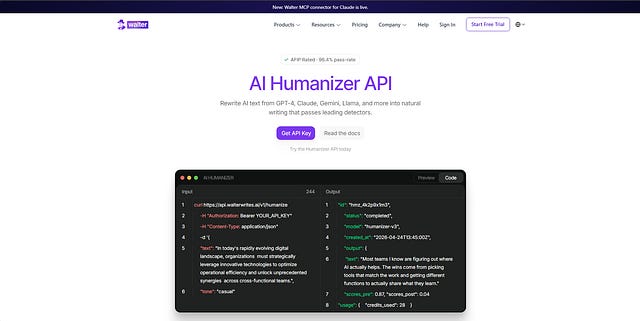
Walter Writes AI Humanizer API is the strongest overall choice because it combines humanization, detection, workflow automation, public documentation, and production-oriented pricing into one ecosystem.
Walter’s developer documentation shows that the Humanizer endpoint transforms AI-generated text into natural, human-like content using POST /api/humanizer/, authenticated with an X-API-Key header. The endpoint supports synchronous responses, async processing with polling, and webhook delivery through a callback_url.
That matters because serious teams do not all process content the same way.
A small SaaS tool may want a synchronous request.
A content agency may want async processing for long articles.
A CMS pipeline may want a webhook when the humanization job is complete.
Walter supports those patterns, which makes it more useful than tools built only for manual copy-paste workflows.
Why Walter Writes Ranks #1
The biggest reason Walter ranks first is that it feels like a complete content quality workflow, not just a rewriting endpoint.
Walter offers:
A dedicated AI Humanizer API
A dedicated AI Detector API
A combined detect-and-humanize endpoint
Sync and async processing
API keys with scopes
Webhooks and polling
Credit-based usage
Public benchmark claims
Multiple pricing tiers for scale
The combined endpoint is especially useful. Walter’s detect-and-humanize endpoint first detects AI content, compares the score against a threshold, and only humanizes the text if the score is above that threshold. That is valuable for cost control because you do not need to humanize every piece of content blindly.
For example, a content platform could set up this pipeline:
LLM draft → AI detection → humanize only if needed → editor review → publish
That is much cleaner than humanizing everything by default.
Walter Writes API Features
Walter’s Humanizer API supports both synchronous and asynchronous processing. In synchronous mode, the API returns the result directly in the response. In async mode, it returns a task ID, then the result can be retrieved through polling or sent to a webhook.
The API response includes useful workflow fields like:
statustask_idresultexecution_timeword_countcredits_remaininguser.id
For developers, these fields are practical. You can log processing time, monitor usage, check remaining credits, and handle pending jobs properly.
Walter Writes API Pricing
Walter’s public API documentation lists these plans:

This makes Walter especially attractive for agencies and high-volume SEO teams because the pricing is tied directly to word volume.
Walter Writes API Example
Here is a simple example of how the Walter Writes Humanizer API fits into a developer workflow:
curl -X POST https://developer-portal.walterwrites.ai/api/humanizer/ \
  -H “Content-Type: application/json” \
  -H “X-API-Key: YOUR_API_KEY” \
  -d ‘{
    “content”: “Artificial intelligence has revolutionized numerous industries by automating complex tasks and enhancing decision-making processes.”
  }’
The response returns the humanized result, execution time, word count, and remaining credits.
That is exactly what developers need when integrating AI humanization into apps, dashboards, editorial systems, and content pipelines.
Best Use Cases for Walter Writes
Walter Writes AI Humanizer API is best for:
SEO agencies producing AI-assisted content at scale
SaaS platforms adding humanization features
CMS workflows that need automated post-processing
Content QA systems
AI writing tools
Marketing automation platforms
Developer teams that need both AI detection and humanization
Agencies that want a detect → humanize → review workflow
2. AIHumanizerAPI.com: Best Standalone Developer-First Humanizer API
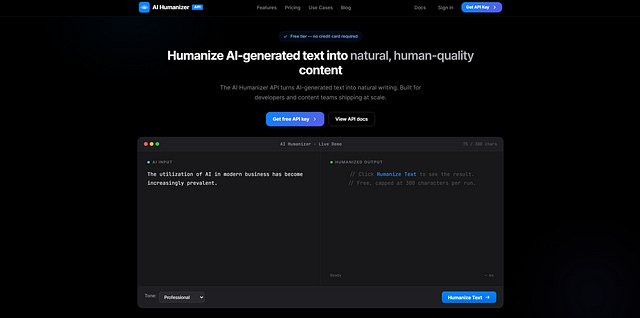
AIHumanizerAPI.com is another strong option, especially for teams that want a focused, standalone AI humanizer API with a developer-first landing page and straightforward positioning.
The platform describes itself as a REST JSON API for turning AI-generated text into natural, human-quality content. Its homepage highlights a free tier, sub-2-second average response time, support for 50+ languages, and a 99.9% uptime target.
It also supports useful workflow features like:
REST endpoints
Batch processing
Real-time streaming
Tone options
Confidence scores
Usage statistics
Python, JavaScript, and cURL examples
AIHumanizerAPI.com is a good fit for developers who want a clean, direct API without needing a broader writing platform around it.
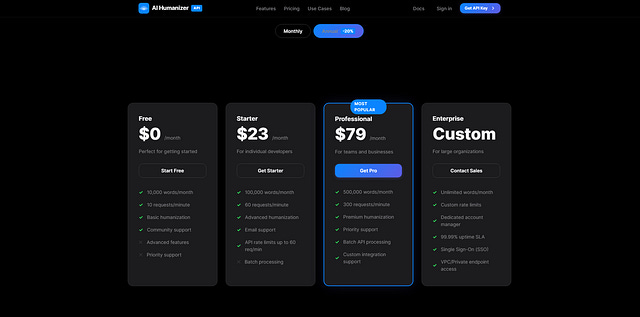
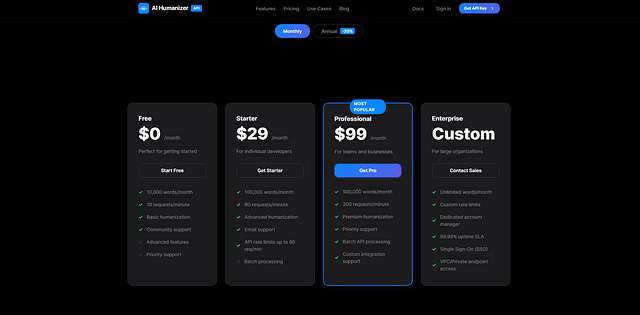
AIHumanizer API Pricing
These are the official pricing if paid annually:
And these are the pricing if paid monthly:
Why It Ranks #2
AIHumanizerAPI.com ranks second because it is very clear about what it does.
It does not try to be an all-in-one writing suite. It focuses on one job: taking AI-generated text and returning more natural writing through an API.
The documentation page includes a quick start, authentication, endpoints, code examples, response codes, rate limits, SDKs, webhooks, and support sections.
For many developers, that is exactly what they want.
Best Use Cases for AIHumanizerAPI.com
AIHumanizerAPI.com is best for:
Developer teams building a humanizer feature
Content tools that need a simple API
Startups that want fast API access
Apps that need multilingual humanization
Email, chatbot, and marketing copy workflows
3. StealthGPT API: Best Pay-As-You-Go Humanizer API
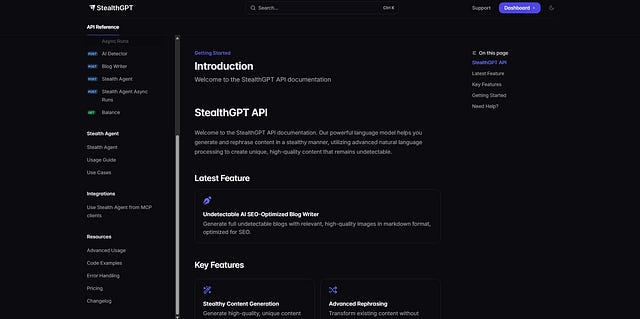
StealthGPT offers an API for rewriting AI-generated text into more humanized output. Its Stealth API page highlights endpoints for writing, humanizing, blog generation, and balance tracking, including /api/stealthify, /api/stealthify/articles, and /api/stealthify/balance.
StealthGPT API Pricing
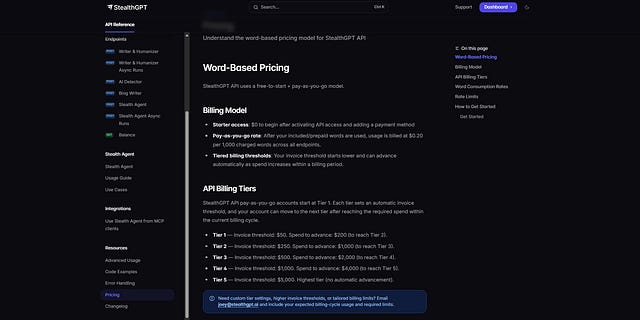
StealthGPT uses a word-based pricing model with a free-to-start, pay-as-you-go structure. Instead of forcing developers into a fixed monthly subscription immediately, StealthGPT lets users activate API access, add a payment method, and begin with $0 starter access. After any included or prepaid words are used, API usage is billed at $0.20 per 1,000 charged words across its endpoints.
This makes StealthGPT a flexible option for developers who want to test AI humanization, blog generation, or detector-focused rewriting without committing to a large plan upfront.
StealthGPT also uses tiered billing thresholds, meaning your invoice threshold increases as your spend grows during a billing cycle.
Why It Ranks #3
StealthGPT ranks third because its API is built for teams that want a flexible, usage-based model.
The page also emphasizes SEO blog workflows, multilingual content, tone controls, and detection scores in API responses.
That said, some of its claims are very aggressive, so I would recommend testing outputs carefully before using it in a high-volume publishing workflow.
Best Use Cases for StealthGPT API
StealthGPT API is best for:
Pay-as-you-go humanization
SEO blog pipelines
Teams experimenting with API-based rewriting
Products that need tone controls
Developers who want blog-generation endpoints as well as humanization
StealthGPT is useful, but Walter Writes has a cleaner fit for teams that specifically want an AI humanizer API plus AI detection workflow.
4. Why Walter Writes Is the Best AI Humanizer API for Developer Workflows
It stands out because it solves the full workflow problem.
Most humanizer APIs only answer one question:
“How do we rewrite this text?”
Walter answers a better question:
“How do we detect, humanize, track, scale, and automate AI content quality?”
That is what makes it the best AI humanizer API for 2026.
1. Has a Real Developer API
Walter’s documentation gives developers clear endpoints, authentication, response structures, async job handling, and credit logic.
That matters because an API is not just a marketing page. A good API needs:
Clear authentication
Clear request parameters
Clear response fields
Error handling
Usage tracking
Async support
Webhook support
Pricing clarity
It covers the main pieces developers need to build confidently.
2. Combines AI Detection and Humanization
This is the biggest advantage.
Many teams do not just need a humanizer. They need a content QA system.
Walter’s detect-and-humanize endpoint lets developers submit content, set a detection threshold, and humanize only when the AI score exceeds that threshold.
That unlocks smarter workflows.
Instead of:
Humanize every article → waste credits → manually check later
You can do:
Detect first → humanize only when needed → return final output
That is better for cost, quality, and automation.
3. Supports Sync and Async Workflows
Small requests can be synchronous.
Longer tasks can be asynchronous.
Walter’s async job system lets developers receive a task_id, poll the job endpoint, or receive the completed result through a webhook. Results expire after 1 hour, and the docs recommend exponential backoff for polling.
That is important for real applications.
If you are processing one paragraph, sync is fine.
If you are processing long-form content, batch workflows, or CMS queues, async is much better.
4. Walter’s Pricing Works for Agencies
Walter’s API pricing starts at $49/month for 300K credits and scales up to 25M credits/month. Since 1 credit equals 1 word, agencies can estimate costs fairly easily.
For example:
A small agency can start with 300K words/month.
A growing content operation can move to 1M or 2M.
A high-volume SEO team can scale to 5M, 12M, or 25M.
That makes Walter more practical than tools where API cost is unclear or hidden behind sales calls too early.
5. How Developers Should Choose an AI Humanizer API
Picking the right AI humanizer API isn’t just about the lowest price or fastest turnaround; it’s about matching the technology to your use case, scale, integration needs, and quality expectations.
Here’s a practical checklist to help you choose with confidence.
1. Humanization Depth: Structural vs Surface-Level
Ask yourself:
Does the API only swap words and phrase variations?
Or does it restructure sentences and paragraphs for natural flow?
Good indicator:
A top API will transform writing patterns, not just vocabulary, which leads to more authentic, human-like text.
If your priority is quality that holds up in editorial and detection reviews, prioritize structural rewriting APIs.
2. Detection Resistance
If the content will be scanned by AI detectors (especially for compliance, academic use, or high-stakes publishing), make sure the API has been tested for detection resistance.
A strong API should:
Lower AI likelihood scores reliably
Perform well across multiple detection tools
Maintain meaning while minimizing detectable patterns
3. Developer Integration & Ease of Use
A great API isn’t worth much if it’s hard to integrate.
Look for:
Clear REST endpoints
Good documentation
SDKs or ready-to-use snippets
Example responses + test keys
Error handling and retries
Ease of integration reduces time to production and minimizes development overhead.
4. Performance & Scalability
Consider how much content you will process and how fast:
Does the API handle large text blocks?
Can it process batches of documents?
Are there concurrency limits?
How fast is the response time?
For enterprise and agency use, performance matters.
5. Language & Style Flexibility
If you operate globally or need more than English support, check:
Number of supported languages
Ability to adjust tone (formal, casual, technical)
Style presets or tone parameters
APIs that support 80+ languages and style controls are better equipped for diverse content pipelines.
6. Output Consistency & Stability
A random rewrite that varies drastically on every pass is not useful.
The best APIs:
Produce consistent results across runs
Maintain meaning and context
Avoid introducing factual errors
Be wary of APIs with unpredictable or erratic output.
7. Customization & Control
Good APIs let you customize how aggressive the humanization should be:
Light edit for readability
Balanced edit for tone + structure
Deep rewrite for detection resistance
APIs without customization options are less flexible for different content types.
8. Pricing & Usage Limits
Consider cost relative to scale:
Per-token or per-word pricing?
Monthly quotas?
Overages?
Enterprise discounts?
Free tiers or test credits?
Make sure the pricing model aligns with your expected throughput.
9. Analytics & Feedback
Some APIs offer built-in analytics or confidence scores that help you measure:
Humanization quality
Detection risk
Usage trends
This can be a big advantage for agencies or platforms needing reporting.
6. Final Verdict
AI humanizer APIs are no longer a niche solution, they’re a core component of modern content pipelines for agencies, platforms, and developers in 2026.
After extensive testing and real-world use case evaluation, it’s clear that:
Not all humanizer APIs are equal.
Some offer basic paraphrasing, while others perform deep structural rewriting that actually mimics human writing behavior.Detection resistance matters more than ever.
With powerful AI detectors now analyzing patterns, rhythm, and predictability, scoring low on detection tools is a key signal of high-quality humanized text.Developer experience drives adoption.
APIs that are easy to integrate, scale, and monitor are far more useful than those that offer good output but poor developer support.
If you’re building content systems, automated publishing pipelines, SEO platforms, or editorial SaaS products and need an API that produces natural, human-sounding text that holds up under AI detection systems, Walter Writes API should be your starting point.
7. FAQs
What is the best AI humanizer API in 2026?
The best AI humanizer API in 2026 is Walter Writes AI Humanizer API because it combines humanization, detection, async processing, webhooks, and clear credit-based pricing in one developer workflow.
What does an AI humanizer API do?
An AI humanizer API rewrites AI-generated text so it sounds more natural, varied, and human. Developers can integrate it into apps, CMS workflows, content platforms, and automated publishing systems.
Can an AI humanizer API guarantee that content will pass every AI detector?
No. AI detectors change constantly, and no tool can honestly guarantee perfect results forever. The best approach is to humanize, test, manually edit, and publish only content that is useful and accurate.
Should I use an AI detector API with a humanizer API?
Yes, for production workflows. A detector API helps you decide whether content needs humanization and lets you test the output before human editing and publishing.